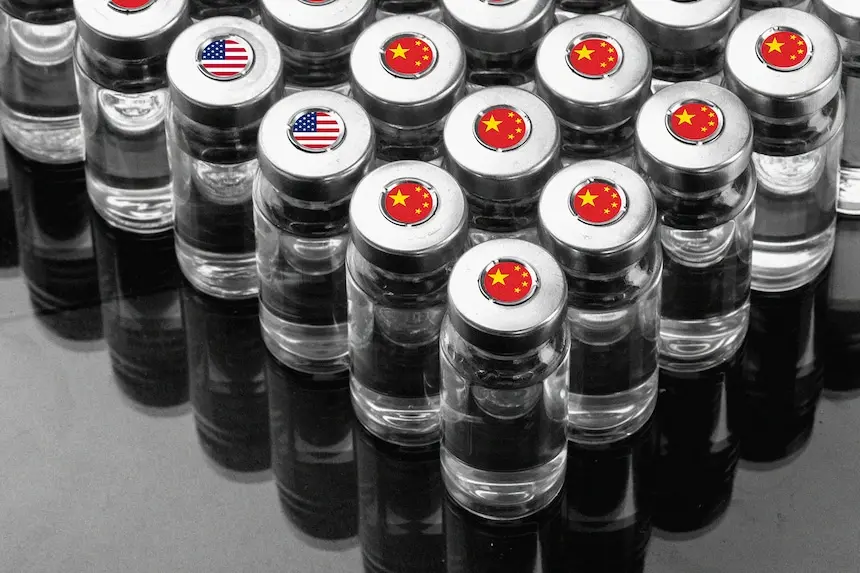
Health experts and industry executives warn that growing reliance on Chinese manufacturing for active pharmaceutical ingredients and essential medicines could leave the United States vulnerable to supply disruptions, geopolitical tensions and future public health emergencies.
America's Medicine Supply Chain Faces Growing Dependence
For decades, the United States has steadily shifted much of its pharmaceutical manufacturing overseas, particularly the production of active pharmaceutical ingredients (APIs)—the essential chemical compounds used to make medicines. Today, China has become one of the world's largest producers of APIs and key raw materials used in antibiotics, cardiovascular drugs, pain medications and numerous other life-saving treatments. Industry experts warn that while globalization has reduced manufacturing costs, it has also created strategic vulnerabilities that could threaten the reliability of America's medicine supply during periods of geopolitical conflict, trade disputes or public health crises. The COVID-19 pandemic exposed weaknesses in global medical supply chains, leading policymakers to reconsider how dependent the country has become on foreign manufacturers for products critical to national health. Temporary shortages of personal protective equipment, medical devices and pharmaceuticals demonstrated how quickly international disruptions can affect hospitals and patients. Although many finished medicines consumed in the United States are manufactured domestically or in allied countries, a significant portion of their ingredients originate from overseas suppliers. Analysts say this concentration of production creates risks that extend well beyond ordinary commercial competition.
China Dominates Key Pharmaceutical Ingredients
China plays a central role in the global pharmaceutical manufacturing ecosystem by producing a substantial share of the active ingredients and chemical precursors used by drug manufacturers around the world. Many pharmaceutical companies purchase these materials because China's large-scale production capabilities and lower manufacturing costs help reduce overall medicine prices. However, experts caution that dependence on a relatively small number of overseas suppliers may leave healthcare systems vulnerable if production is interrupted by natural disasters, export restrictions, political disputes or manufacturing problems. Even temporary disruptions can create shortages of critical medicines that hospitals rely upon for routine surgeries, emergency care and chronic disease management. Certain generic medicines are considered especially vulnerable because profit margins are relatively low, leaving fewer manufacturers willing to maintain redundant production capacity. As more production becomes concentrated among a limited number of global suppliers, resilience decreases if one major facility experiences difficulties. Healthcare economists argue that balancing affordability with supply-chain security has become one of the pharmaceutical industry's most important long-term challenges.
National Security and Public Health Concerns Are Increasing
Government officials, healthcare organizations and national security experts have increasingly described pharmaceutical supply chains as an important strategic issue rather than simply a commercial concern. Reliable access to antibiotics, cancer treatments, anesthetics and emergency medications is considered essential not only during pandemics but also during natural disasters, military conflicts and other national emergencies. Several U.S. government reports have recommended expanding domestic manufacturing capacity for essential medicines while strengthening supply chains through partnerships with allied countries. Policymakers have proposed financial incentives, tax credits and procurement reforms designed to encourage pharmaceutical companies to diversify production rather than relying heavily on a single country. Some experts emphasize that reducing dependence does not necessarily require ending trade with China. Instead, they advocate creating more geographically diverse manufacturing networks capable of maintaining production even if one region experiences disruption. Pharmaceutical companies have also begun investing in advanced manufacturing technologies that may allow certain medicines to be produced more efficiently within the United States and other partner nations.
Reshoring Drug Manufacturing Presents Major Challenges
Despite broad agreement that supply-chain resilience should improve, rebuilding domestic pharmaceutical manufacturing is a complex and expensive undertaking. Constructing new production facilities requires billions of dollars in investment, years of regulatory approvals and a highly skilled workforce capable of meeting strict quality standards. Many economists note that overseas manufacturing became dominant largely because of lower production costs, established industrial infrastructure and extensive supplier networks developed over several decades. Replicating these advantages domestically would require sustained government support alongside significant private-sector investment. In addition, pharmaceutical companies must comply with rigorous safety and quality regulations regardless of where medicines are produced. Expanding domestic capacity therefore involves not only constructing factories but also developing reliable sources of raw materials, specialized equipment and technical expertise. Industry leaders increasingly advocate a balanced strategy that combines domestic production of essential medicines with diversified international sourcing rather than attempting complete self-sufficiency.
Diversification May Be the Key to Future Resilience
The debate over pharmaceutical dependence reflects broader questions about globalization, economic security and public health preparedness. While international supply chains have helped make medicines more affordable and widely available, recent global events have demonstrated the importance of ensuring that essential healthcare products remain accessible during periods of disruption. Experts generally agree that strengthening resilience will require cooperation among governments, pharmaceutical manufacturers, healthcare providers and international partners. Expanding domestic production, increasing strategic stockpiles, improving supply-chain transparency and encouraging diversified manufacturing across multiple countries are all viewed as complementary strategies rather than mutually exclusive solutions. As demand for medicines continues to grow alongside aging populations and emerging health challenges, ensuring stable access to life-saving drugs is likely to remain a major policy priority. Whether through reshoring production, strengthening partnerships with trusted allies or investing in advanced manufacturing technologies, reducing excessive dependence on any single supplier is increasingly seen as essential for protecting both public health and national security. The evolving pharmaceutical landscape underscores that reliable medicine supply chains are no longer viewed solely as an economic issue but as a critical component of modern healthcare resilience.